What we’ve built for ourselves.
We run our own production systems. It keeps us honest. What we’ve learned from watching our own infrastructure break at 2am, then getting it back running, is what shapes the services we offer to clients.
SCORE
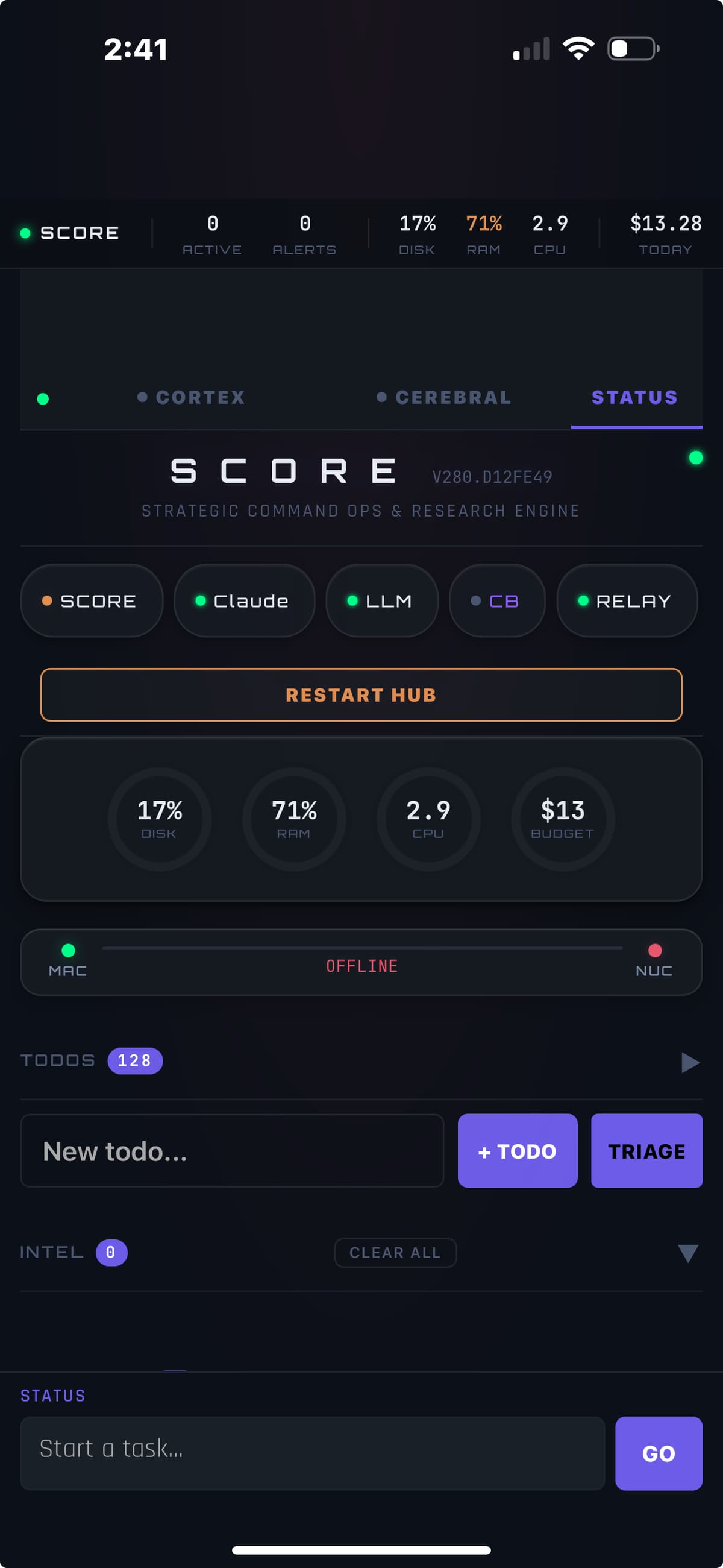
LIVEAn AI partner that remembers. SCORE holds months of context in memory — past projects, active decisions, threads you left open last week. Come back three weeks later and it already knows what you were in the middle of.
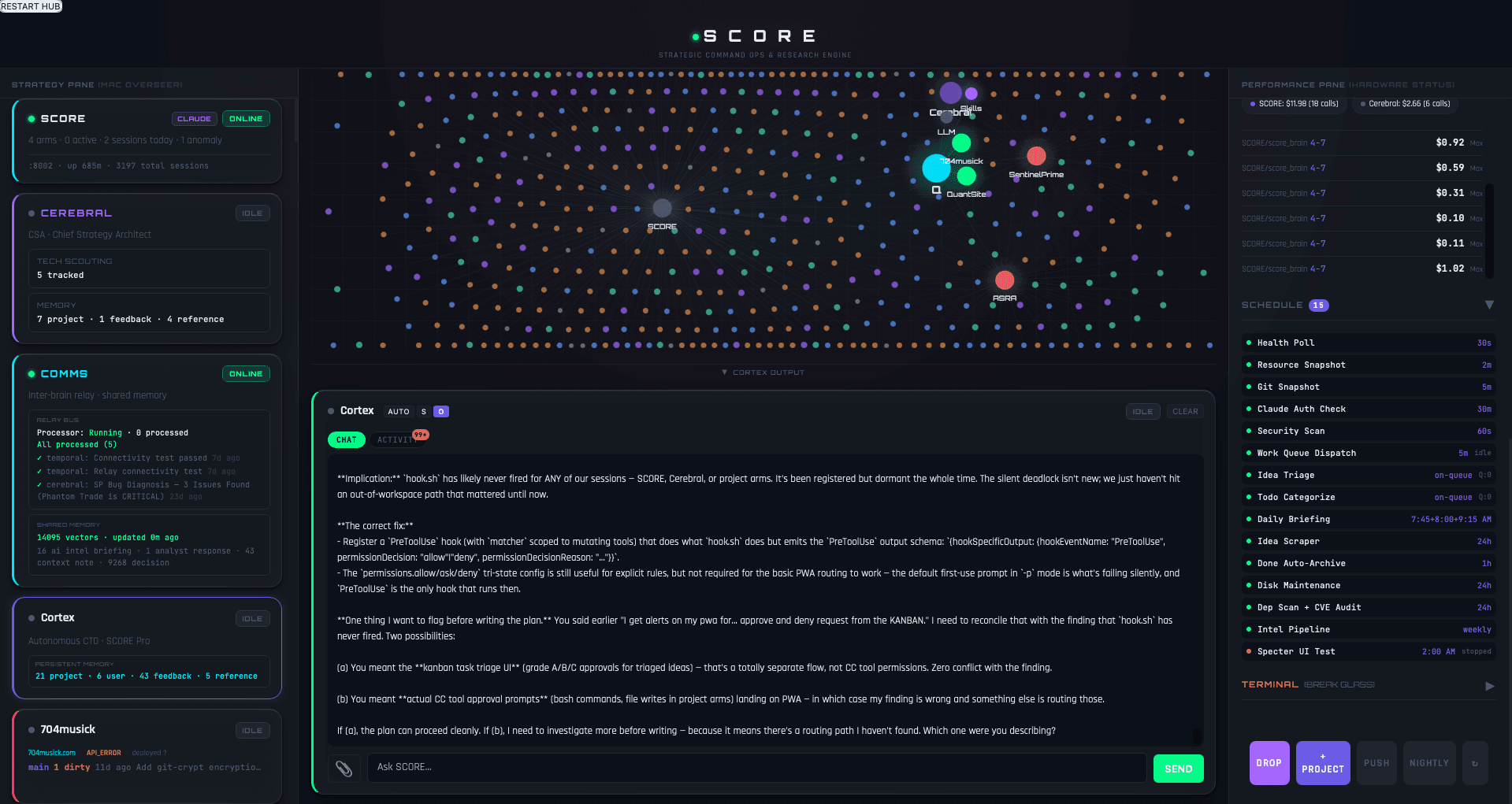
Persistent memory across months
Past conversations, decisions, and findings stay searchable by meaning or by exact phrase. Ask what you planned in March, or what you decided about vendor X. The answer comes from actual history.
Multi-brain architecture
One brain for strategy and architecture. A separate brain for execution and shipping code. Each keeps its own scoped memory, so context from one role doesn't leak into the other.
Autonomous work queue
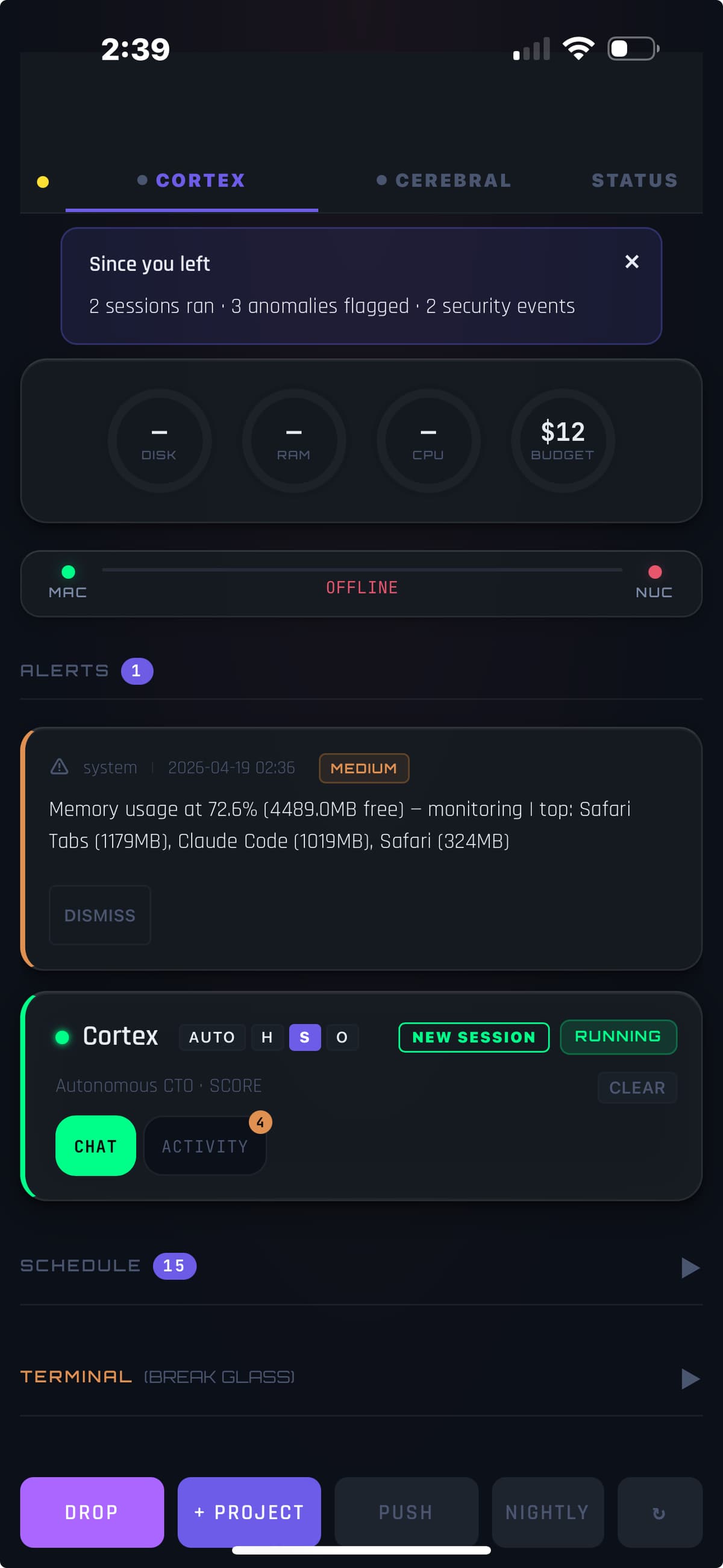
Queued work runs in the background while you’re away from the keyboard. Code tasks, documentation, research. If the system hits something that needs your call, it pings your phone.
Daily briefings
Scheduled briefings cover system health, markets, and anything waiting on a decision. You sit down already caught up instead of spending half an hour rebuilding context.
CodeGate QA pipeline
Every meaningful build runs through a construction-grade review chain before it ships. Evidence check, architecture audit, adversarial diff review by rotating personas. Bugs get caught before they reach production.
Push approval for risky actions
When the AI wants to do something consequential — delete a file, push a commit, send an email — it pauses and asks. A notification lands on your lock screen. Tap allow or deny, and it continues.
SentinelPrime
LIVEAn autonomous trading system that runs across multiple brokers and handles both equities and futures. Between every signal and execution sits a mandatory AI risk gate. Five separate checks have to pass before a trade fires.
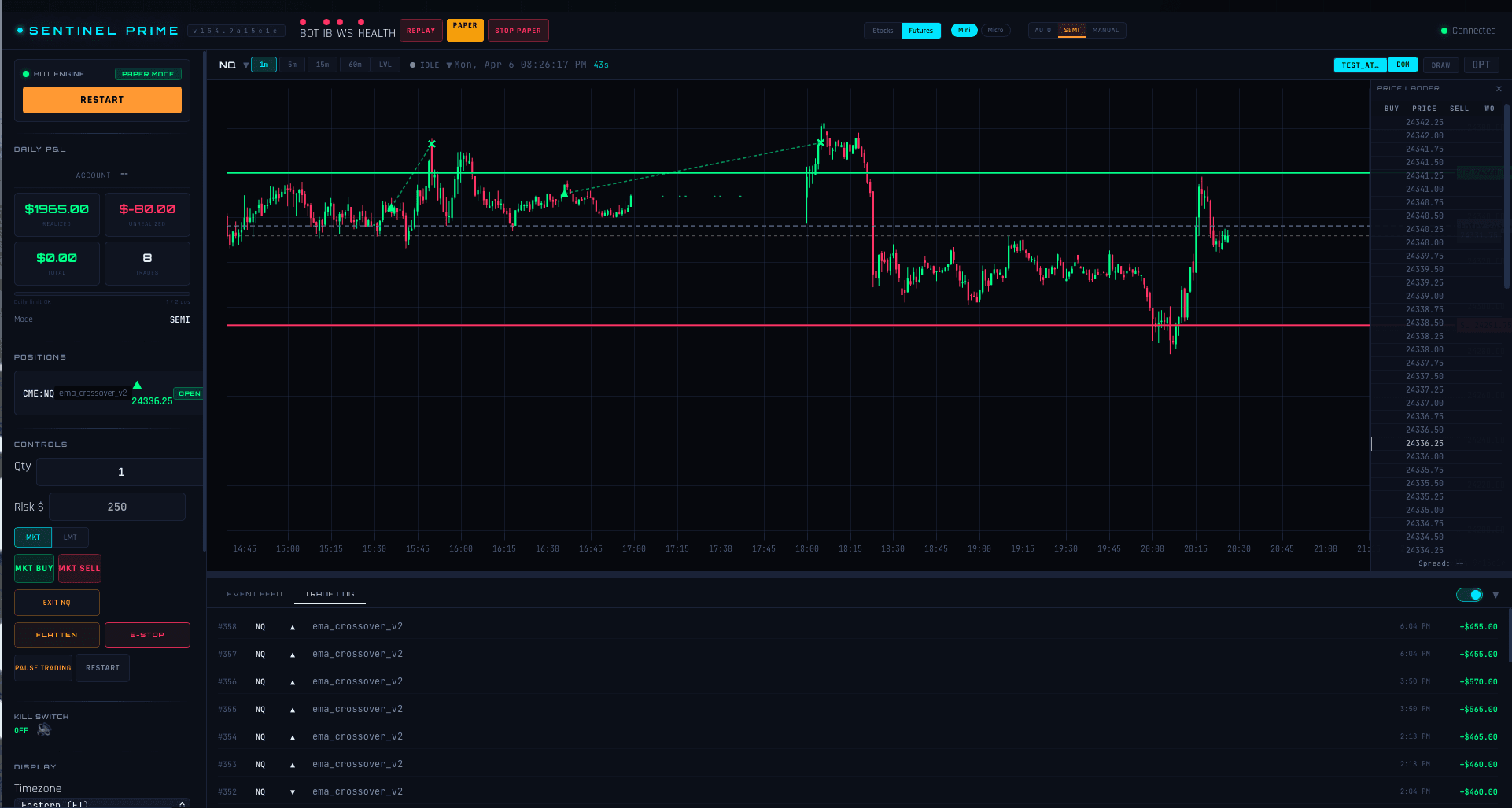
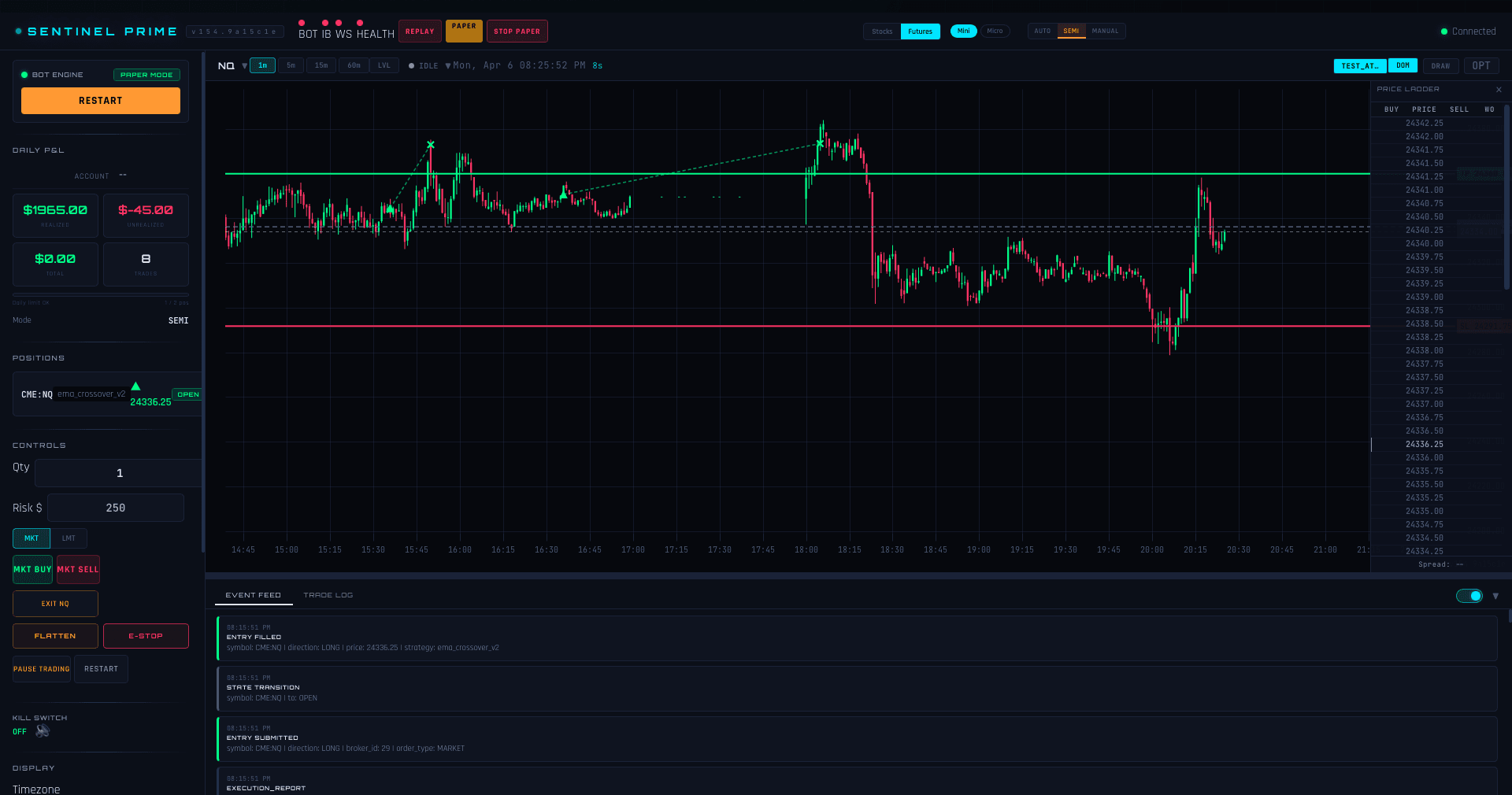
Replay mode — practice without a broker
Run any strategy on any past trading day. The whole live pipeline (strategy, risk gate, execution) runs exactly as it would in real time, just fed from historical tick files. No broker connection, no money at risk. Scrub through last Tuesday’s open at any speed and watch what would have happened.
Five-layer AI risk gate
Every trade signal runs through five checks before execution: AI confidence on the setup, kill switch status, daily loss ceiling, position limits, and a live price sanity check. One fail means no trade.
Paper trading on live data
Run the full system against real-time market data with simulated fills. Same tick feed as production, same decisions, zero money at risk. The right way to test a strategy before committing capital.
Broker-agnostic by design
The core trading logic doesn’t care where orders route. A clean adapter layer handles each broker’s quirks, so swapping platforms doesn’t mean rewriting the system.
Multi-leg profit taking
Exit a position in stages instead of an all-or-nothing target. Keep partial exposure when a move continues, lock in progress when it stalls.
Tick-level backtests with walk-forward validation
Most DIY systems backtest on one-minute bars. This one replays every tick the market printed. Walk-forward validation then checks whether winners hold up on unseen data, rather than just the training window.
News pauses and automatic contract rolls
Scheduled high-impact news (FOMC, CPI, NFP) pauses trading automatically until the dust settles. Futures contract expirations get rolled without operator intervention.
SentinelEQ
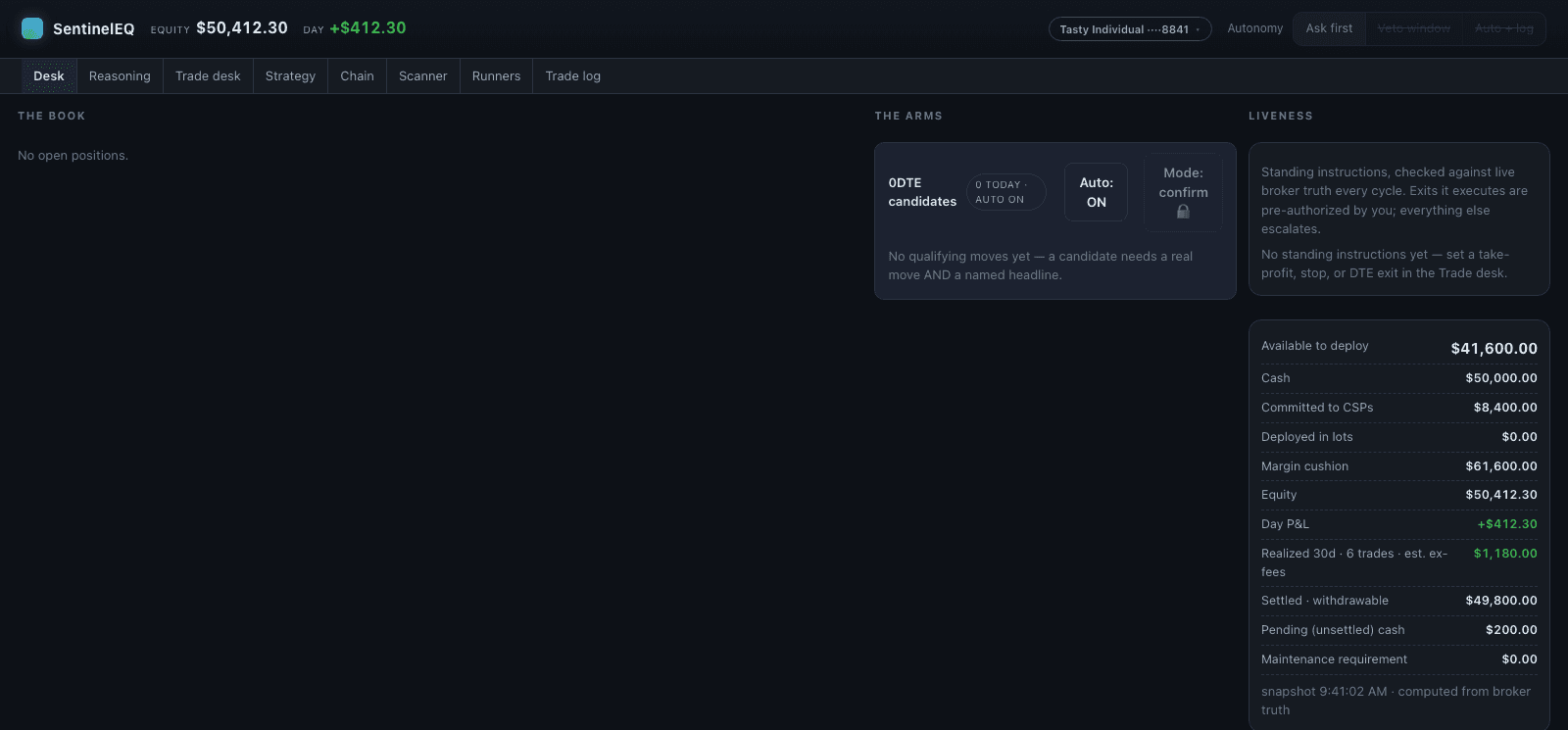
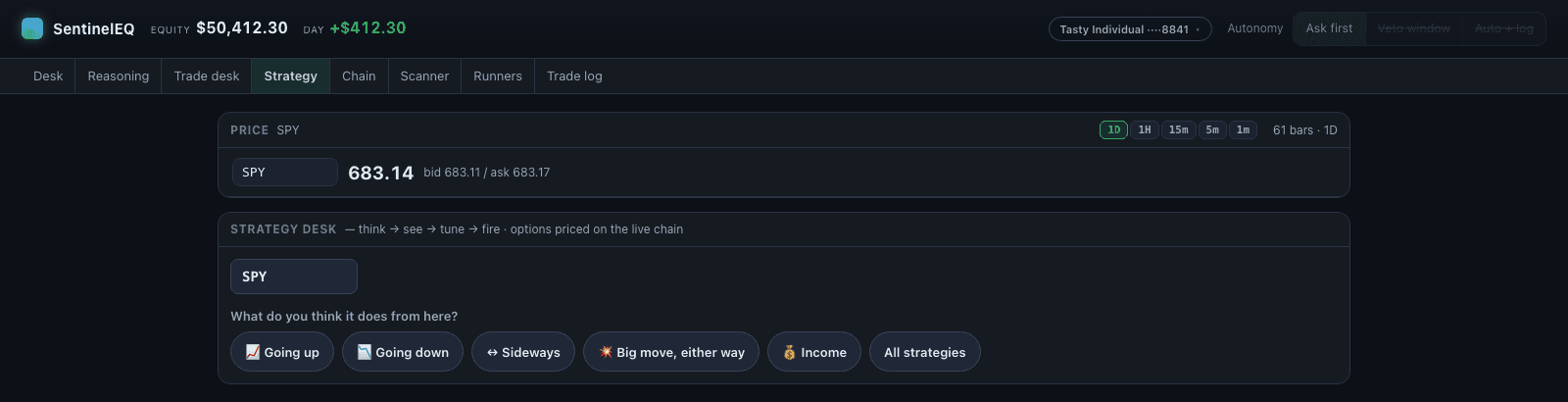
TUNINGA guided stocks-and-options trading platform, built alongside SentinelPrime but scoped differently — individual equities and options instead of futures, and built to teach the reasoning behind every trade instead of just firing signals. One pluggable engine runs six option structures against a live account behind a hard pre-trade risk gate.
Portfolio-aware scanner
Candidates are ranked against the book you already hold, not screened in isolation. Ideas get demoted for capital you don't have, positions you're already in, sector overlap, or directional imbalance against your net portfolio delta.
Six-structure options engine, one pluggable core
Cash-secured puts, credit spreads, debit spreads, iron condors, and covered calls all run through a single scanning engine on a shared yield and probability-of-profit ranking ladder. New structures register as plugins with zero changes to the core.
A living thesis on every position
Each open trade carries an AI-generated narrative — why it was entered, how it's tracking, what the planned exit is — built strictly from real account facts. The model phrases the reasoning; it never invents a number it wasn't given.
Standing exit instructions, always watching
Per-position profit targets, max-loss stops, and DTE-based exits run as scheduled jobs against live quotes around the clock. It only executes exits you pre-authorized — it never opens a new position on its own.
Dual-broker, real-time data
Runs the same strategy code across a paper-validation lane and a live-execution lane with real-time quotes and greeks. Prove a strategy on paper before it ever touches a live order.
Pre-trade proposal gate
Every order, human-placed or bot-generated, passes through a risk-profile check that shows the ledger impact before it fires. Hard limits can't be overridden while the bot is trading autonomously.
Research-backed, not guesswork
Trade rationale pulls from SEC EDGAR fundamentals and live news and corporate-action feeds. If a source doesn't have a number, the field reports unavailable — never a guess.
API Synth
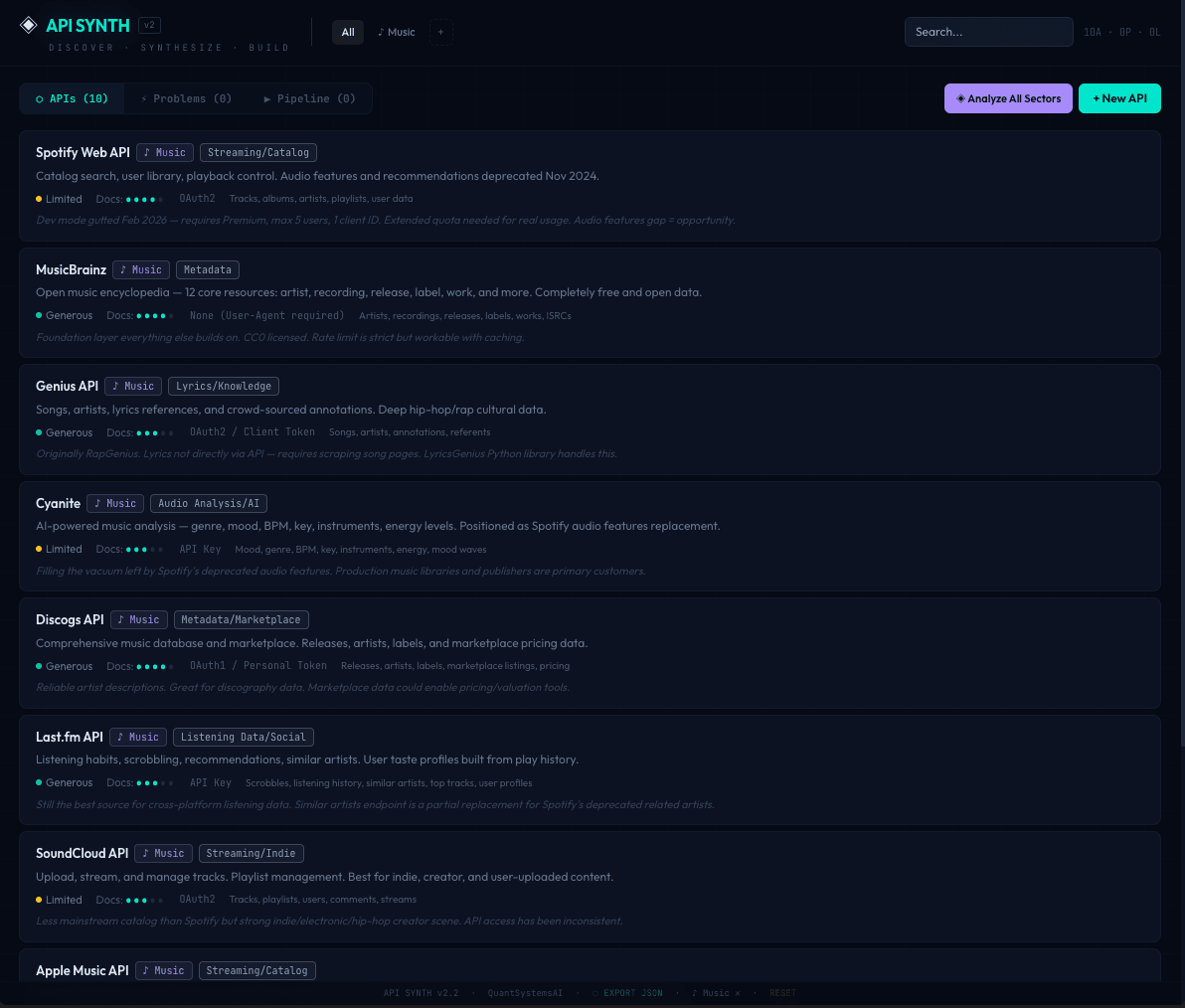
BETAThe opportunity discovery layer for AI-augmented builders. API Synth catalogs public APIs across any sector and uses AI to reason across them, surfacing specific problems the APIs could solve and combinations that create products none of them ship alone. Feed it a sector and it returns a shortlist of real opportunities with evidence attached — target users, market sketches, competitive scans, and build complexity estimates.
Sector-organized API registry
A structured catalog of public APIs grouped by industry. Each entry captures what matters for build decisions — free tier generosity, docs quality, auth complexity, rate limits, response format, and real-time capability. The entries answer one question: can I ship with this?
Problem surfacing with evidence
For any API or group of APIs in the catalog, the system generates specific problems they could solve. Each suggestion comes with a target user, a market size estimate, and a competitive scan. If something like it already exists, the scan flags it upfront so you don’t spend cycles rebuilding.
Mashup detection
AI reasons across the full catalog at once to find combinations that create products none of the individual APIs ship. Each combination comes with a technical complexity estimate, integration notes, and a competitor scan. Combinations are what the system exists to surface, because that’s where most novel product opportunities tend to hide.
Validation pipeline
A kanban board that tracks ideas through four stages — Idea, Research, Prototype, Ship. Each card carries a five-point validation checklist: competitor check, demand signal, willingness to pay, build estimate, and technical feasibility. Cards can’t advance to Prototype until the checklist has evidence attached.
Want systems like these for your business?
The AI Systems Audit is where every engagement starts. We assess your operations and build a clear roadmap.